Fragmented history
Pricing evidence was spread across contracts, vendors, projects and Excel files rather than one reusable reference base.
FEATURED CASE STUDY 02 · PRICING INTELLIGENCE
An internal tender-pricing decision-support system that turns historical contract and vendor data into searchable, comparable pricing evidence for new BOQ items, individually or in bulk.
CONTEXT & ORIGIN
Contract archives contained years of BOQ descriptions, vendors and agreed rates, but the value of that history depended on being able to retrieve a genuinely comparable item quickly. Different wording, specifications, units and file structures made simple lookup unreliable.
BOQ Pricing Intelligence was built to convert that fragmented contract history into a structured internal pricing knowledge base, then place retrieval, comparison and review inside one practical tendering workflow.
THE PRICING PROBLEM
The system was designed around the gap between having contract data and being able to use that data safely and quickly during tender pricing.
Pricing evidence was spread across contracts, vendors, projects and Excel files rather than one reusable reference base.
The same commercial item can appear under different wording, abbreviations, typos and levels of specification.
Sizes, units and technical parameters matter. A close text match can still be commercially misleading if the specification differs.
Pricing one line is easy to review manually. Pricing an entire client BOQ requires a repeatable workflow for matches, exceptions and exports.
PRICING INTELLIGENCE ARCHITECTURE
The system separates data structure, matching logic and commercial review so that historical prices support a decision rather than replace one.
01 · HISTORICAL DATA
02 · INTELLIGENT RETRIEVAL
Semantic and keyword retrieval, supported by filters, specification anchors, unit normalization and ranked similarity.
03 · COMMERCIAL REVIEW
04 · TENDER SUPPORT
A reviewed reference set that helps pricing teams benchmark new BOQ items and identify where manual pricing is still required.
SYSTEM EVIDENCE
The application supports both focused item research and batch tender workflows, while keeping the underlying historical evidence visible to the reviewer.
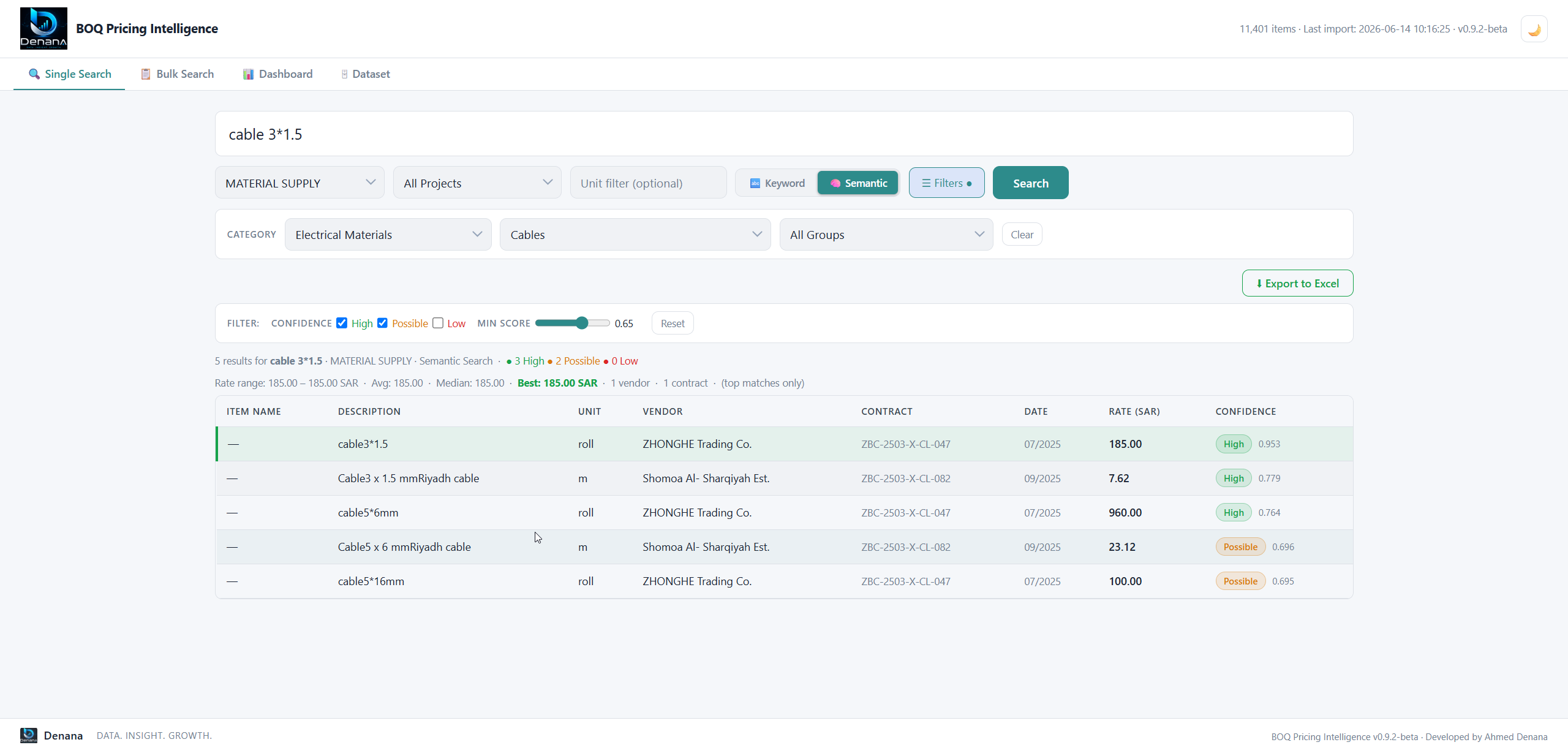
01 · SINGLE ITEM SEARCH
Comparable historical referencesSearch a new BOQ description, filter the evidence set and review matching vendors, contracts, dates, rates and similarity confidence.Open full-size view ↗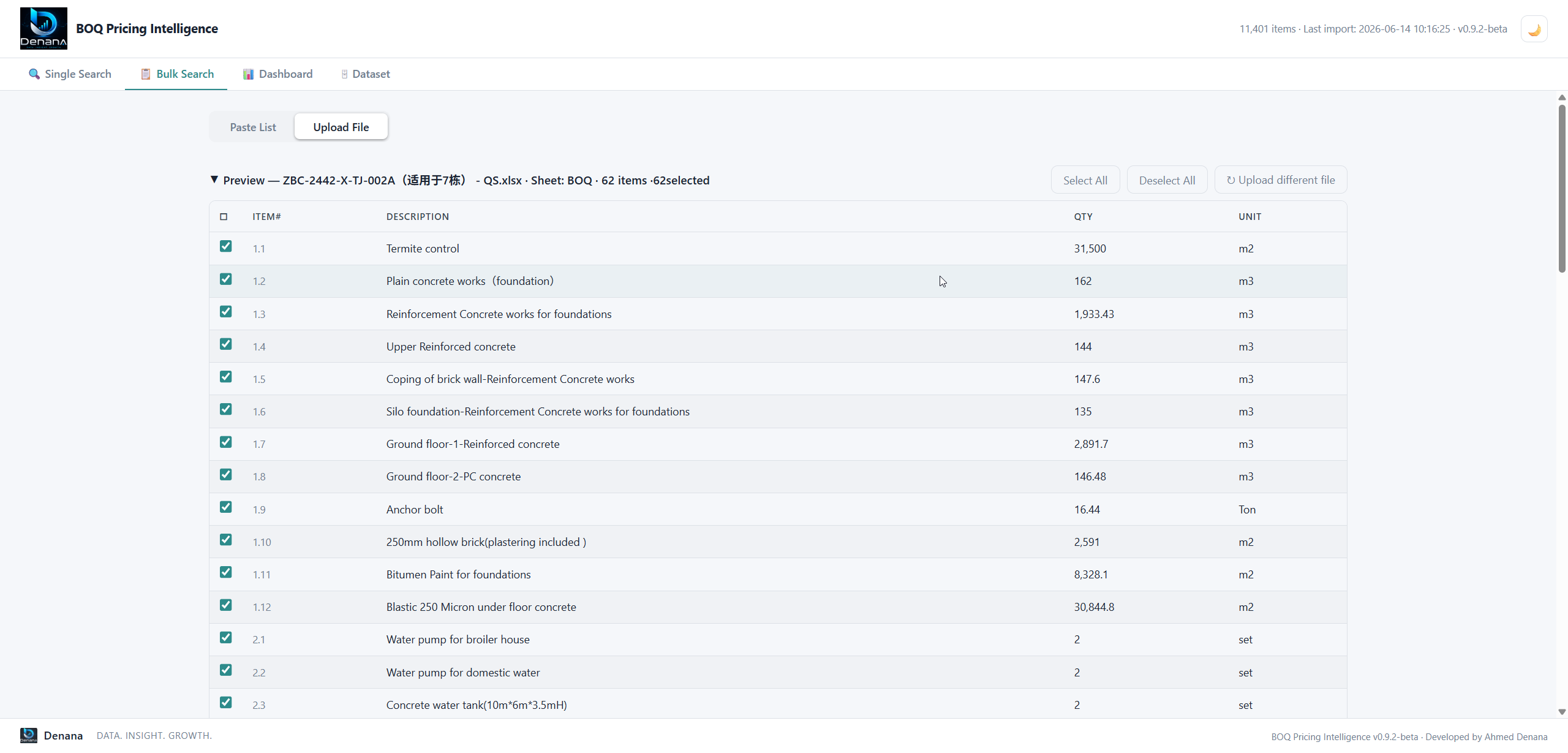
02 · CLIENT BOQ INTAKE
Review before matchingUpload an Excel BOQ, choose the relevant sheet, inspect the parsed items and exclude rows that should not enter the pricing search.Open full-size view ↗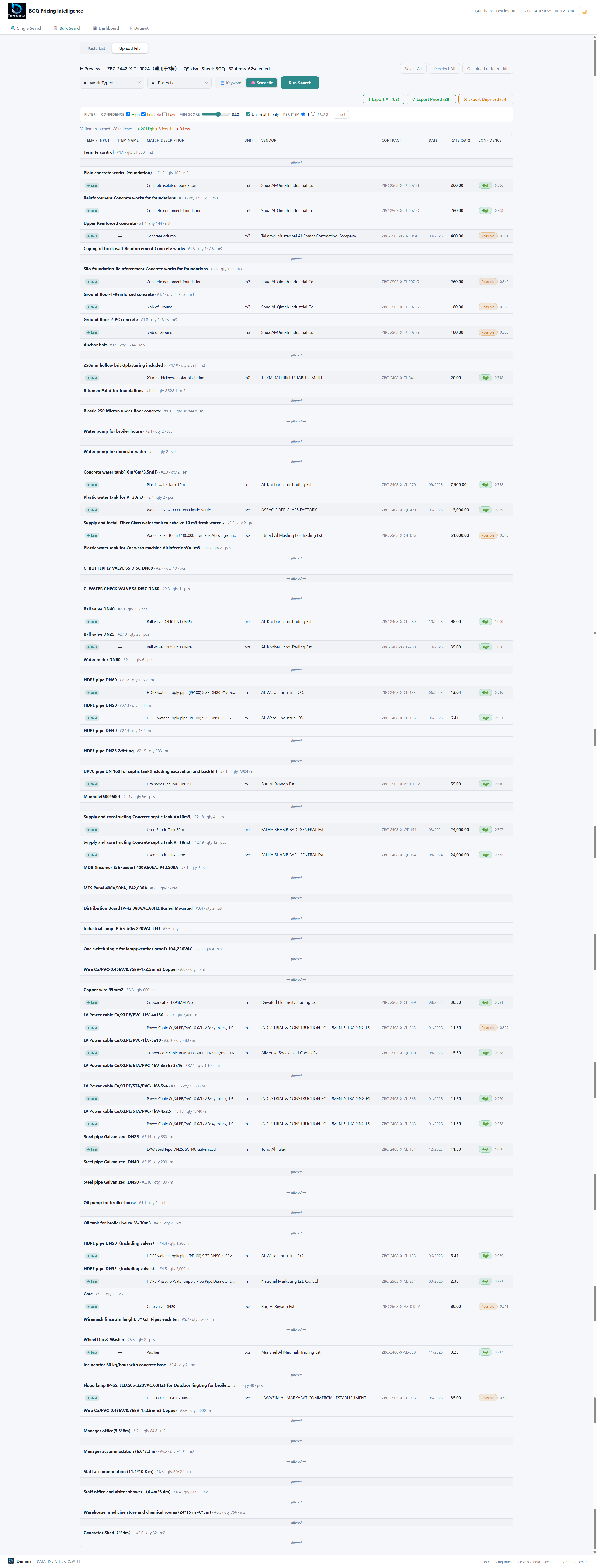
03 · BULK PRICING REVIEW
Entire BOQs, not just one searchRun the confirmed BOQ through the matching engine, review top references item by item and separate weak or missing matches for manual pricing.Open full-size view ↗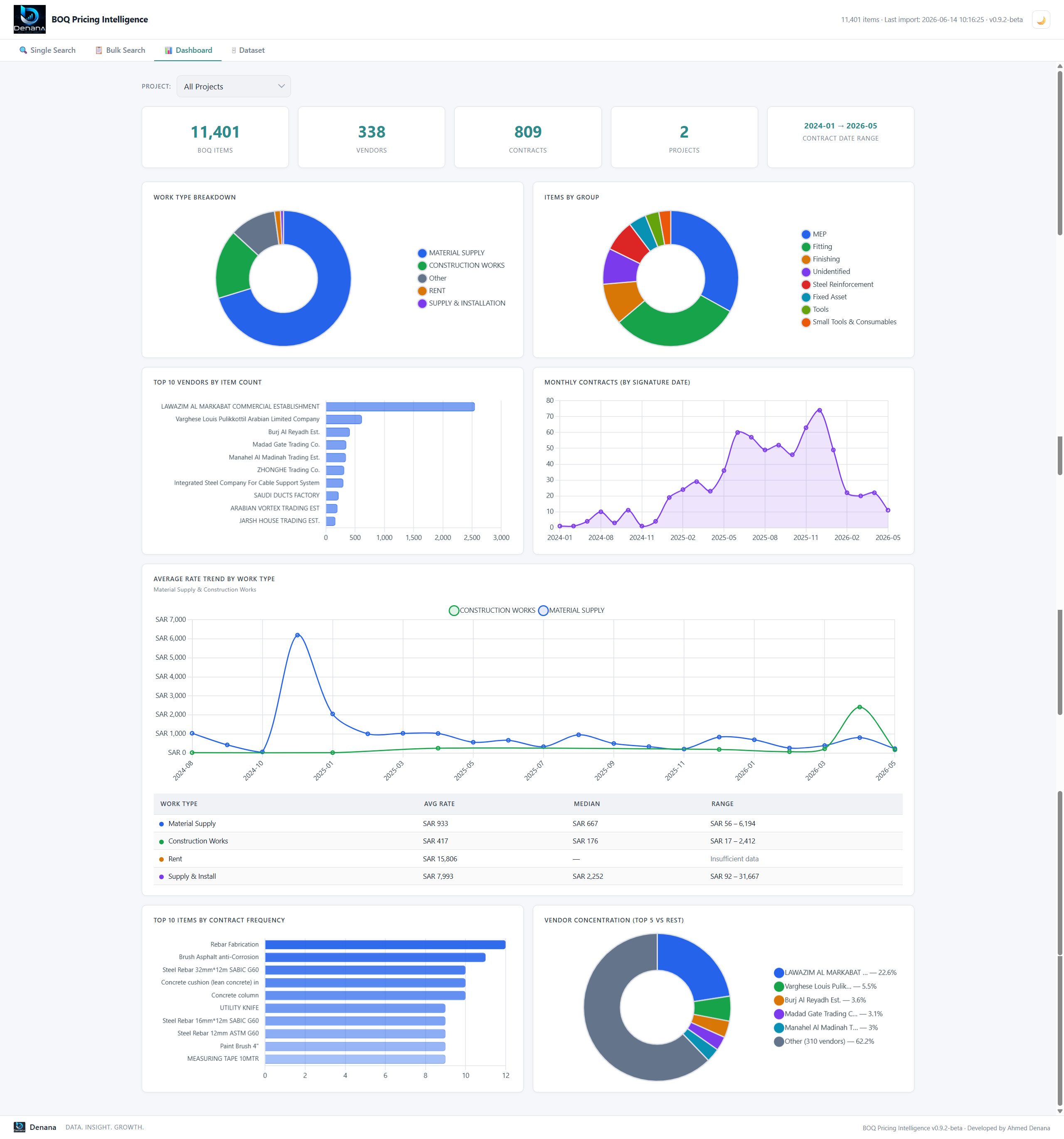
04 · PRICING KNOWLEDGE BASE
History becomes visibleUse the accumulated database to inspect item volumes, vendors, contracts, work types, recurring items, price trends and vendor concentration.Open full-size view ↗MATCHING LOGIC
The search engine combines several matching layers because BOQ descriptions are rarely clean enough for one technique to be reliable on its own.
Sentence-transformer embeddings retrieve similar descriptions even when wording differs.
Character n-gram TF-IDF supports exact codes, part numbers and specification-heavy searches.
Numeric and size tokens such as DN, mm, kV, kW, PN and cable sizes influence ranking.
Normalized units strengthen comparable matches and penalize incompatible ones.
Work type, project, category, subcategory and item group narrow the evidence set.
Scores describe match similarity, not whether a quoted rate is commercially correct.
HOW IT WORKS
The workflow keeps retrieval and judgment separate: the system finds and organizes evidence, while the pricing reviewer decides how that evidence should be used.
Import and normalize historical contracts, vendors and BOQ items into a reusable pricing knowledge base.
Use semantic or keyword search with work-type, category, project and unit filters to retrieve relevant references.
Strengthen retrieval with typo handling, numeric and size/spec anchoring, and unit-aware ranking.
Compare vendors, contracts, dates, rates and match confidence before accepting a reference.
Move reviewed results into Excel outputs, with unmatched or low-confidence items isolated for manual pricing.
WHAT THE SYSTEM ENABLES
MY ROLE
The project started from a cost-control and tender-pricing problem rather than a software brief. I designed the data structure, search workflow, matching logic and review outputs around the way historical pricing evidence is actually used during tender preparation.
CASE STUDY 02
Turning historical contract data into practical tender-pricing intelligence.